You don't have any items in your cart.

How to Easily Switch from Stick Welding to MIG Welding
Learning how to switch from stick welding to MIG is easier when you understand the differences in wire feeding, shielding gas and welding technique. Your existing arc-control skills can also help shorten the learning curve.
I. Understand the Key Differences Between Stick Welding and MIG Welding
Common Problems When Switching from Stick Welding to MIG
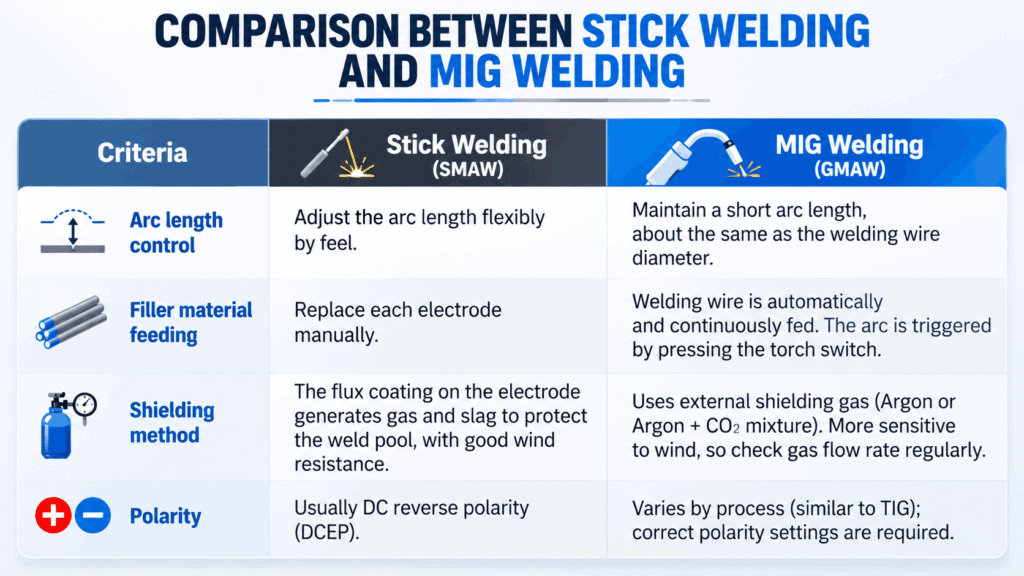
Before switching from stick welding to MIG welding, it is important to understand how these two welding processes work:
- Stick welding (SMAW): Uses gases and slag generated by the electrode coating to protect the weld pool.
- MIG welding: Uses an external shielding gas, such as Argon or an Argon + CO₂ mixture, to isolate the weld pool from the surrounding air. Welding wire is automatically fed through the torch, eliminating the need to manually replace electrodes.
II. Step-by-Step Training Guide for New MIG Welders
Step 1: Get Familiar with the Equipment and Arc Starting Method
- Unlike stick welding, where the electrode must be scratched or tapped against the workpiece to initiate the arc, a MIG welder automatically feeds the wire and starts the arc when the trigger is pressed.
- Practice tip: Try pressing the trigger several times before welding to become familiar with the wire-feed speed and gas flow.
Remember this simple rule:
“Press the trigger = Wire feed + Gas flow + Arc ignition.”
Step 2: Control the Arc Length – Extremely Important
- In stick welding, arc length is often controlled by hand and judged by sound. With MIG welding, however, you need to maintain a short and stable arc, with the arc length approximately equal to the wire diameter.
Common mistakes to avoid:
- Arc too long: May cause arc deflection, poor shielding, porosity, shallow penetration, and increased spatter.
- Arc too short: The wire may easily stick to the workpiece.
Practice tip: Practise on scrap material first. When you hear a stable buzzing sound, it usually indicates that the arc length is being maintained properly.
Step 3: Adjust the Welding Torch Angle Correctly
The torch angle used in MIG welding differs from stick welding and needs to be controlled carefully.
- Recommended travel angle: Maintain an angle of approximately 10°–15°, with the torch pointing slightly in the direction of travel, to help stabilise the weld pool and improve penetration.
Torch angle according to joint position:
- Butt joint: Maintain a work angle of 90°.
- Fillet weld: Approximately 45°.
- Thicker material: Tilt the torch slightly towards the vertical plate to improve penetration.
Step 4: Take Full Advantage of Continuous Wire Feeding
- Stick welding is limited by electrode length, resulting in shorter weld sections and more stop-start points.
- MIG welding continuously feeds wire, allowing longer welds to be completed in a single pass and significantly reducing the number of interruptions.
This can greatly improve productivity while helping create more uniform weld beads, making MIG welding particularly suitable for repetitive and mass-production applications.
III. Common Problems and How to Fix Them
Porosity
Cause: Insufficient shielding gas flow or wind at the worksite. MIG welding is generally more sensitive to wind than stick welding.
Solution: Use wind protection when welding outdoors. Select a suitable shielding gas, such as Argon for non-ferrous metals or an Argon + CO₂ mixture for high-strength steel.
Welding Wire Sticks to the Workpiece
Cause: The arc is too short or the wire-feed speed is too high.
Solution: Reduce the initial wire-feed speed, then gradually increase it once the welding process becomes stable.
Weld Bead Is Too Narrow and Too High
Cause: Travel speed is too slow.
Solution: Because MIG welding has a relatively high deposition rate, the torch generally needs to be moved faster than in stick welding.
IV. Practical Advice for Customers
Traditional stick welding is far from outdated.
Stick welding equipment is simple and performs well in windy conditions, making it a strong choice for outdoor maintenance and repair work.
A practical approach is to combine both welding processes:
- Use MIG welding to improve productivity in fabrication workshops and mass-production environments.
- Keep stick welding for emergency outdoor repairs or mobile jobsite applications.
A small tip: Spend around one to two weeks practising short-arc control and torch angles on scrap material before moving on to actual products.
Once you become familiar with the process, the continuity and appearance of MIG welds can provide a significant advantage in both productivity and finished weld quality.
V. Recommended Hong Ky MIG Welding Machine Categories
How to Switch from Stick Welding to MIG Step by Step
To make the transition from stick welding to MIG welding smoother, you need equipment that is stable and easy to adjust.
As a leading mechanical equipment brand, Hong Ky offers two main MIG welding machine categories suited to different applications.
1. Multi-Process MIG Welding Machines – MIG / TIG / MMA
Suitable for: Welders who want to experience new welding technology while still retaining familiar welding processes.
Advantages: Multiple welding functions are integrated into one machine, allowing users to switch easily between welding modes and become familiar with MIG welding without purchasing several separate machines.
2. Gasless MIG Welding Machines – Flux-Cored Wire
Suitable for: Mobile welders and outdoor jobsite applications.
Advantages: No bulky shielding gas cylinder is required. Simply install a spool of flux-cored wire and the machine is ready to weld.
This makes the setup more compact and convenient while helping reduce the initial equipment investment.
VI. Why Do Metalworkers Choose Hong Ky MIG Welders?
Hong Ky MIG welding machines are designed not only for smoother operation but also to meet the practical needs of professional welders.
Smooth Arc with Reduced Spatter
The electronic control system helps maintain a smoother welding current, supporting more consistent and uniform weld beads.
Strong Resistance to Voltage Drop
The machines are designed to operate reliably even in areas where the electrical supply may be weak or unstable.
Durability Designed for Vietnamese Working Conditions
High-quality components, effective cooling systems, and nationwide warranty support help users feel more confident when operating the machines under demanding workloads.
Explore Hong Ky’s genuine MIG welding machine range here.
Conclusion
Switching from stick welding to MIG becomes much easier once you understand the correct techniques and use suitable equipment. With proper practice, MIG welding can help improve productivity, reduce post-weld cleaning and deliver more consistent weld quality.
Need help choosing the right Hong Ky MIG welding machine for your application?
Contact us today via Hotline: 1900 636 536 for quick support and consultation.