You don't have any items in your cart.

Weld Porosity: Causes and Prevention
Weld Porosity: Causes and Prevention
Does your weld bead look even but contain tiny holes? These may indicate weld porosity, a common welding imperfection.
Porosity can occur in MMA, MIG/MAG, TIG and other welding processes. Understanding its causes helps welders prevent problems and reduce rework.
What Is Weld Porosity?
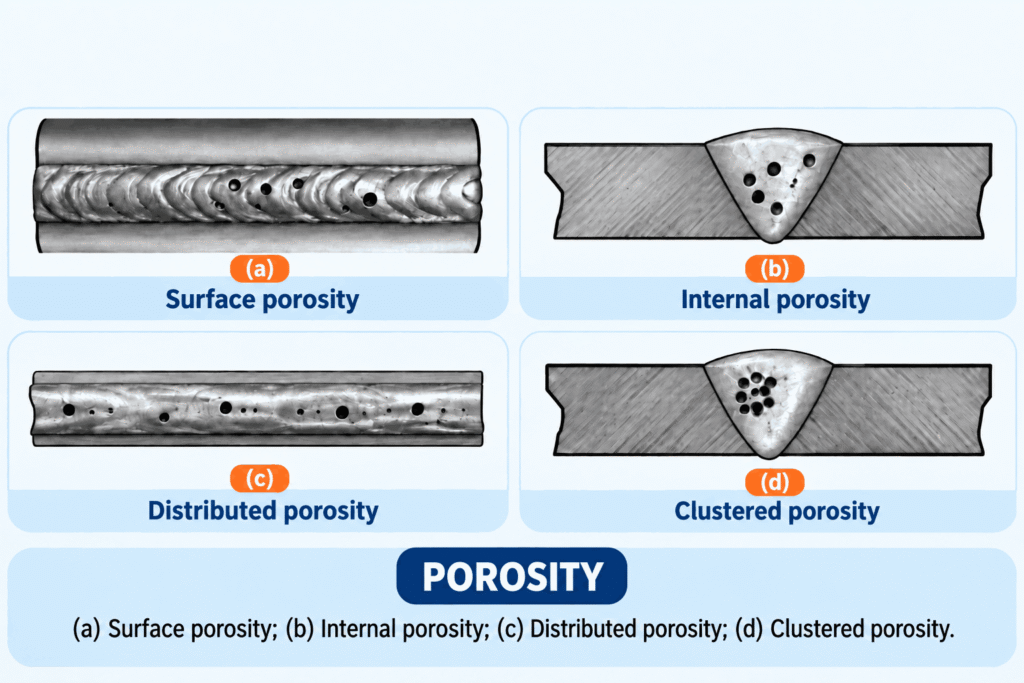
Weld porosity consists of cavities caused by gas becoming trapped as the weld metal solidifies.
These cavities may appear on the surface or remain inside the weld. Visual inspection alone cannot detect every case.
Common Causes of Weld Porosity
Each welding process has different requirements. However, porosity commonly involves one or more of these factors:
- Oil, grease, rust, moisture or dirt on the workpiece.
- Damp or contaminated electrodes, welding wire or flux.
- Interrupted shielding gas, gas leaks or draughts.
- Unsuitable current, voltage, travel speed or arc length.
- Spatter blocking the gas nozzle and disrupting gas coverage.
- Welding techniques that do not suit the material or consumables.
1. Porosity in MMA Welding
Damp electrodes are a common source of porosity in MMA, also known as stick welding.
Oil, moisture and rust on the workpiece can also increase the risk.
An excessively long arc can reduce protection around the weld pool. Unsuitable settings and travel speed can also affect weld formation.
How to Prevent It
- Clean and dry the joint area before welding.
- Select electrodes suitable for the base material.
- Store and dry electrodes according to the manufacturer’s instructions.
- Use suitable current, travel speed and arc length.
If the welding procedure requires preheating, follow the specified temperature. Thick sections do not automatically require preheating.

2. Porosity in MIG/MAG Welding
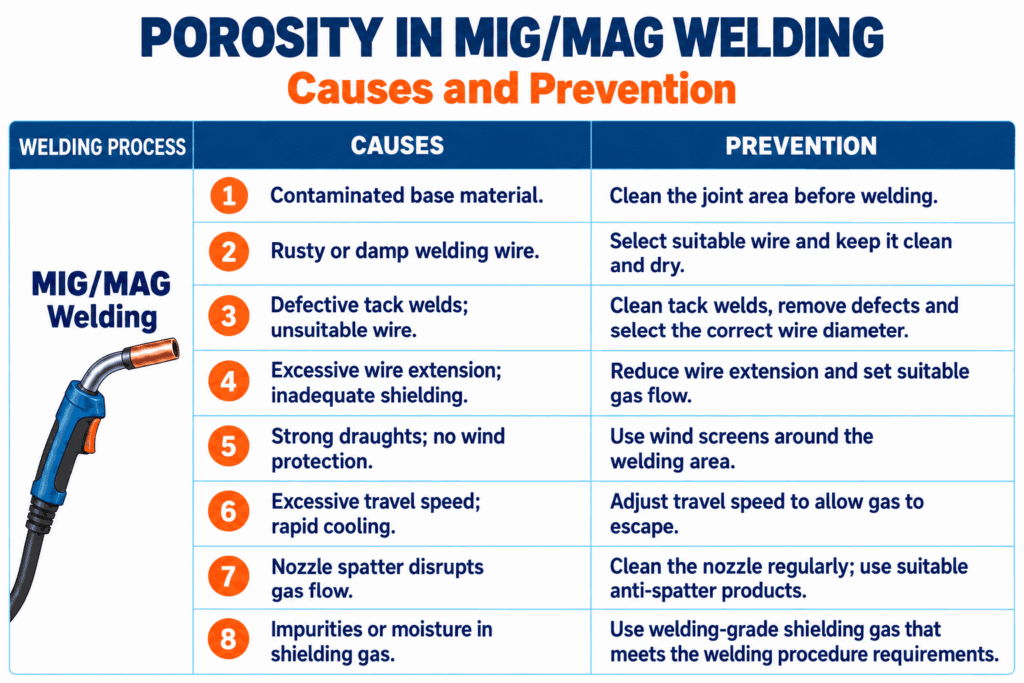
Shielding gas protects molten metal from the surrounding air. Disrupted gas coverage increases the risk of weld porosity.
Common causes include contaminated wire, leaking gas lines and draughts around the joint.
Spatter inside the gas nozzle can also disrupt gas flow and reduce protection.
How to Prevent It
- Clean the workpiece and use clean, dry welding wire.
- Check the gas cylinder, regulator, hoses and connections.
- Remove spatter from the gas nozzle.
- Adjust gas flow to suit the welding conditions.
- Maintain the recommended wire extension and torch angle.
- Use suitable screens to protect the welding area from draughts.
Increasing gas flow excessively can make the problem worse. Too much flow can create turbulence and draw air into the shielding gas.
Use shielding gas suitable for the welding procedure. Welding with CO₂ is technically classified as MAG welding.
3. Porosity in Submerged Arc Welding
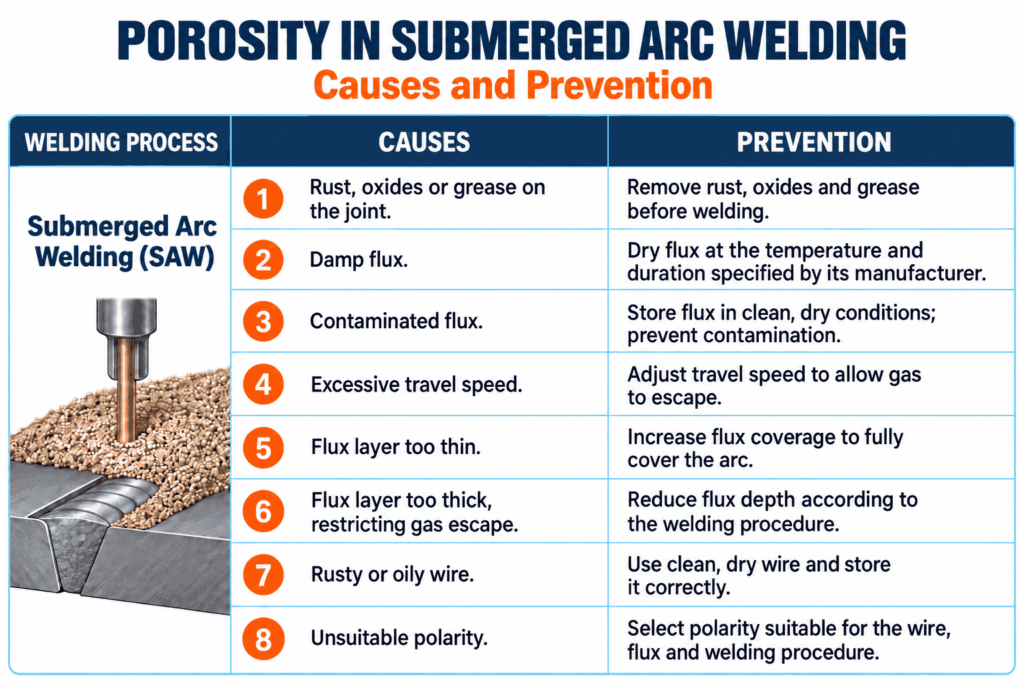
Submerged arc welding, or SAW, uses granular flux to cover the arc and protect the weld pool.
Damp or contaminated flux can cause porosity. Oil and rust on the wire or joint surfaces are other potential sources.
Flux depth must suit the welding procedure. An unsuitable layer can affect protection and gas escape.
How to Prevent It
- Clean the joint surfaces and use clean welding wire.
- Store flux in dry conditions.
- Keep recovered flux free from contamination.
- Adjust flux depth according to the welding procedure.
- Dry flux according to the manufacturer’s instructions.
Drying temperatures vary between flux types. Always follow the instructions for the specific product.
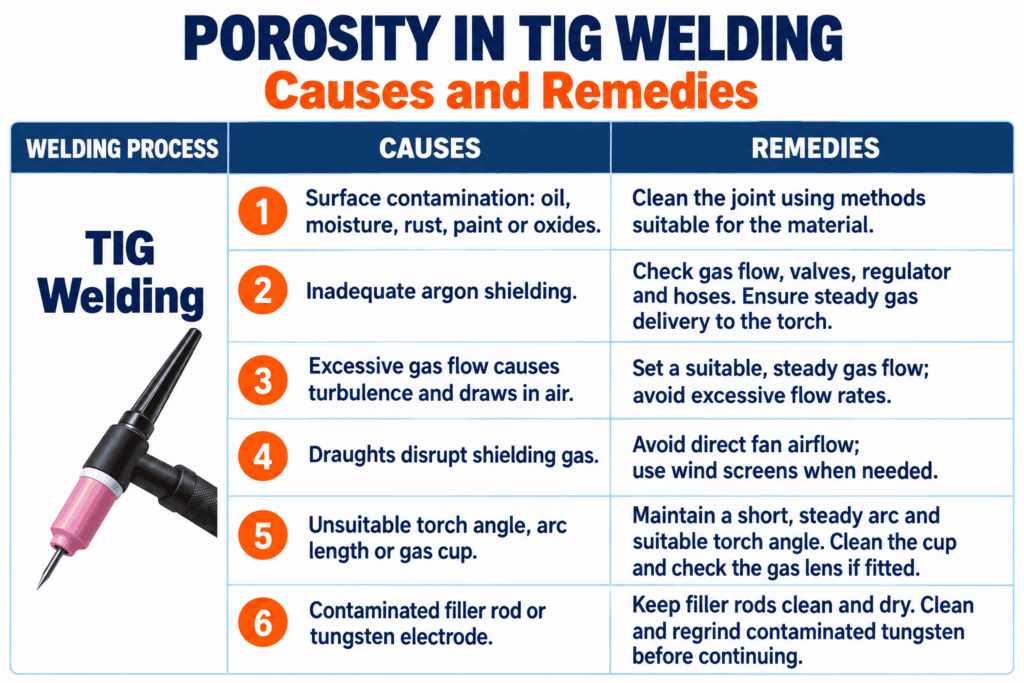
4. Porosity in TIG Welding
TIG welding requires clean materials and effective gas shielding.
Contaminated workpieces, filler rods or tungsten electrodes can affect weld quality. Gas leaks and unsuitable flow rates can also increase porosity risk.
How to Prevent It
- Clean the workpiece and filler rods before welding.
- Keep the tungsten electrode clean and regrind it when contaminated.
- Check gas hoses, connections and the gas cup.
- Set a suitable shielding gas flow rate.
- Maintain a consistent torch angle and suitable arc length.
- Protect the weld area from draughts.
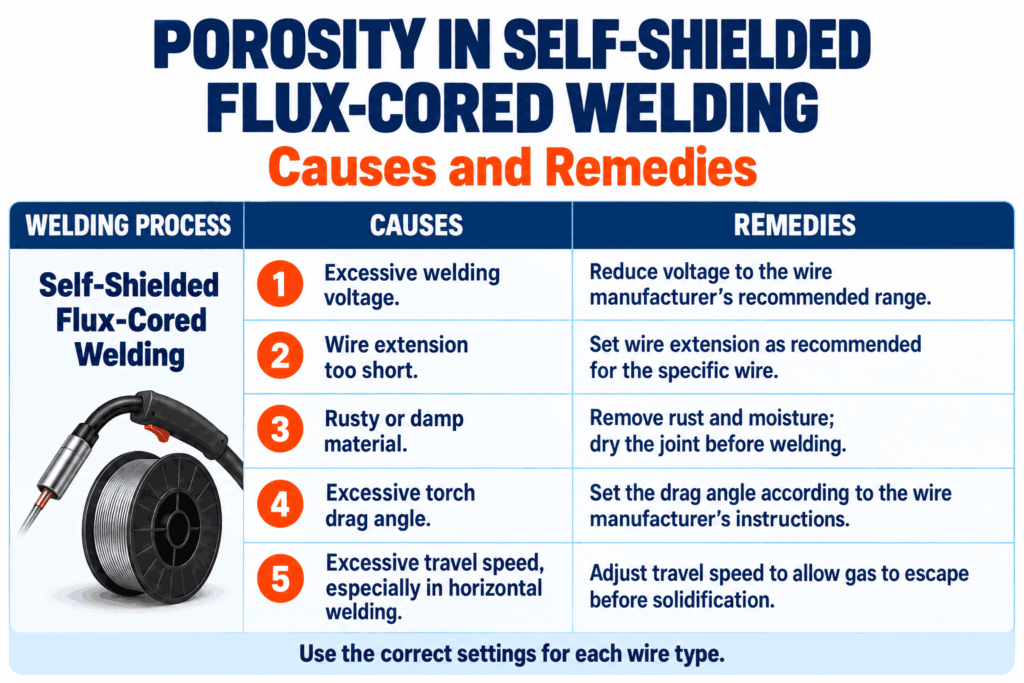
5. Porosity in Self-Shielded Flux-Cored Welding
Self-shielded flux-cored welding does not require an external shielding gas cylinder. However, weld porosity can still occur.
Excessive voltage or incorrect wire extension can affect the wire’s protective action.
Damp, contaminated surfaces and unsuitable welding techniques can also contribute to the problem.
How to Prevent It
- Clean and dry the workpiece.
- Store welding wire according to the manufacturer’s instructions.
- Set the voltage recommended for the specific wire.
- Maintain the correct wire extension.
- Use the recommended drag angle and travel speed.
Each wire has its own operating requirements. Check the product instructions before selecting your settings.
What Should You Check When Weld Porosity Appears?
Check the following areas in sequence:
- Workpiece: Is the joint area clean and dry?
- Consumables: Are the electrodes, wire or flux damp or contaminated?
- Shielding gas: Are there leaks, insufficient coverage or draughts?
- Equipment: Are the nozzle, hoses and connections in good condition?
- Settings: Do they match the material, consumables and welding procedure?
- Technique: Are the torch angle, arc length and travel speed suitable and consistent?
Adjust one factor at a time, then make a test weld.
Changing several settings together makes it harder to identify the cause.
Better Preparation and Control Help Prevent Weld Porosity
Porosity affects more than the appearance of a weld. It can indicate that one or more welding conditions need closer control.
Start with clean materials, suitable consumables, effective shielding and appropriate settings.
Consistent technique also matters. Stable equipment with accessible controls can help welders maintain the required settings.
Hong Ky offers equipment for MMA, MIG/MAG, TIG and self-shielded flux-cored welding. These ranges serve domestic repairs, fabrication workshops and industrial production.
Alongside its equipment, Hong Ky shares technical knowledge, operating guidance and practical welding solutions.
Understanding the cause, correcting the technique and choosing suitable equipment help improve weld consistency and quality.
Contact us now: